A new report from the World Economic Forum and Accenture highlights a waste management crisis most people never see – and a traceability solution that could transform it.
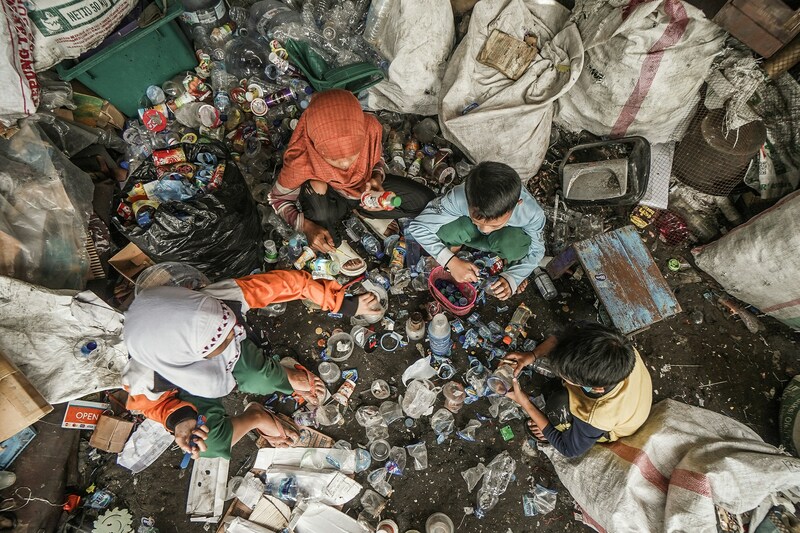
Informal waste management systems currently recover more than 88m tonnes of recyclable materials annually, but these workers – the backbone of global recycling – operate almost entirely outside formal supply chains. WEF estimates that low-income countries dump or burn 93% of their waste, and between 400,000 and one million people die each year from diseases linked to mismanaged waste.
The report argues that traceability innovations can transform informal waste work into verified, transparent supply-chain steps. Technologies such as blockchain, AI analytics and digital payments could bring these workers into traceable systems, proving their contribution and ensuring fair compensation.
Yet less than 0.2% of private capital directed to plastics circularity between 2018 and 2024 went into digital tools such as traceability solutions. As new EU packaging regulations introduce mandatory recycled-content targets from 2026, brands will need proof of where materials come from and who collected them. The infrastructure to deliver that proof currently barely exists.
Regen beer?
Danish brewer Carlsberg is putting regenerative agriculture at the heart of its beer supply chain, aiming for 30% of raw materials to be procured from regen agri sources by 2030 and 100% by 2040. As a brewing company, the company's carbon footprint is largely tied to farming, marking a fundamental shift in how it secures its key ingredient.
Carlsberg has contracted up to 15,000 tonnes of regenerative barley for 2026 through partnerships with a Danish cooperative DLG and Finnish malting company Viking Malt – enough to brew around 100m litres of beer. What began with two pioneering farms will soon expand to more than 50 growers.
Carlsberg's vice president for sustainability and ESG, Simon Boas Hoffmeyer, argues that the biggest barrier to scaling regenerative agriculture is fragmented standards – if every company defines and measures regenerative agriculture differently, scalability will be impossible. Through platforms such as OP2B, “one planet business for biodiversity”, Carlsberg is pushing for harmonised metrics so farmers, companies and policymakers can align on outcomes.
Less green inside
Once a leader in both semiconductor manufacturing and corporate sustainability, Intel is now quietly scaling back its green ambitions. The company used to buy more clean power than any other US tech firm, cutting greenhouse-gas emissions, and pledging aggressive 2030 climate targets, but Intel has suffered a sharp sales decline and lost market share. Reported by organisation Trellis, pressing financial pressures have forced the company to deprioritise some environmental goals.
A key casualty is its scope 3 target, which addressed roughly a quarter of Intel’s emissions from its supply chain. Electricity use is the largest component, and many of the company’s suppliers operate in countries with limited sources of renewable energy.
Plans to cut supply-chain emissions have vanished from the company’s latest corporate responsibility report. Under CEO Lip-Bu Tan, the supply-chain emissions targets have been pushed back decades, and executive pay is no longer tied to emissions reductions.
While a renewed focus on chip design and production efficiency could indirectly reduce emissions, Intel appears to be choosing business survival over earlier environmental commitments.
AFi guidance for all companies
NGO group the Accountability Framework initiative’s new Operational Guidance on Commitments and Progress Pathways is designed to help companies and financial institutions strengthen efforts to eliminate deforestation, land conversion and human rights abuses from their supply chains.
The guidance explains how companies can set credible, responsible supply-chain commitments and how to create realistic, time-bound pathways with milestones and action plans.
As the 2025 global deforestation deadline approaches, the new framework supports companies at all stages - those on track, those behind, and those yet to set any commitments. It also outlines how investors can use these standards to engage companies more effectively. AFi leaders emphasise that 2025 is not the finish line. The new guidance aims to maintain momentum and provide a practical roadmap for continued, measurable progress in protecting forests, ecosystems, and human rights beyond 2025.
What’s the future for recycling?
The US Plastics Pact has published a new position paper clarifying the potential role of physical and chemical recycling in creating a circular economy for plastic packaging. The paper argues that these recycling methods should be used only for plastic materials that can’t be managed through the preferred routes – reduction, reuse or mechanical recycling.
It calls for physical and chemical recycling to complement, not replace, existing recycling systems.
Physical recycling involves solvent‑based processes that clean plastics without altering their molecular structure, while chemical recycling breaks down polymers into their molecular building blocks for reuse as new raw materials.
Mechanical recycling is the process of collecting, sorting, cleaning, and re-melting plastic waste to make new products. It reuses the plastic through physical steps without changing its chemical structure. USPP stresses the need for clear guidelines: independent environmental impact assessments, transparency in recycled‑content claims, and strong safeguards to protect communities near recycling facilities.
Cocoa linked to deforestation, again
A new investigation by Global Witness says some of the world’s biggest chocolate brands are still fuelling rainforest destruction in west Africa. The report links companies including Mars, Nestlé, Mondelez, Hershey and Unilever to cocoa grown on recently deforested land in Liberia.
Between 2021 and 2024, Liberia’s key cocoa-growing region lost forest larger than the size of Luxembourg, as farms pushed deeper into what was once untouched rainforest.
The investigation uncovers how cocoa from recently deforested land enters global supply chains via the mass balance blending. This involves mixing cocoa beans from many farms – meaning that coca linked to deforestation can be blended with certified “sustainable” cocoa, then sold on to major brands.
Global Witness found that no cocoa farms in Liberia are certified by Rainforest Alliance, and experts from WWF say mass-balance systems don’t actually prevent deforestation and can create a hard-to-trace market for cocoa. The report argues that Rainforest Alliance makes significant income from cocoa certification, which critics say can weaken standards, but the organisation says it reinvests this money into sustainability and community projects.
Global Witness put its findings to the major chocolate companies. Mars, Unilever and Nestlé all said they don’t source cocoa directly from Liberia, or that any exposure is “small to negligible”. Mars and Nestlé declined to explain how they prevent Liberian cocoa entering their supply chains, given their reliance on mass-balance systems.