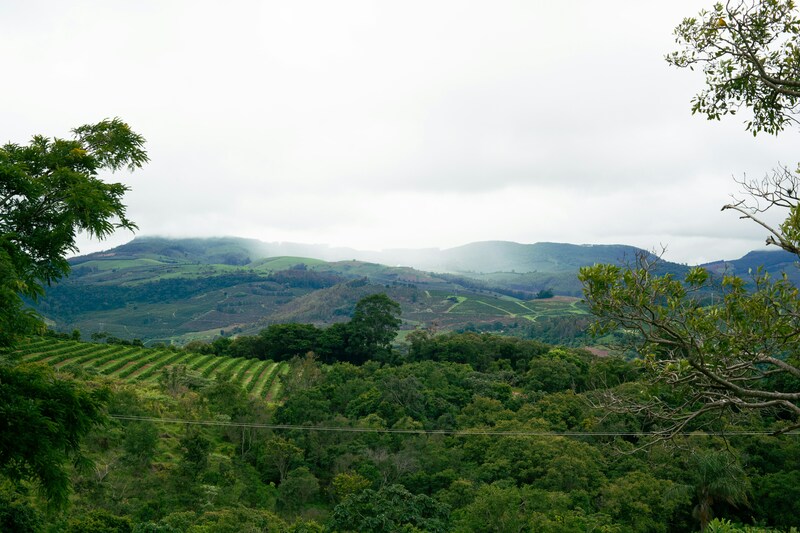
Since its launch in 2015 , the Sustainable Coffee Challenge brings the coffee sector together to confront a rapidly changing climate and to accelerate solutions for a sustainable coffee future.
Ten years after its launch, the Sustainable Coffee Challenge – a global coalition convened by Conservation International – has become one of the most influential multi-stakeholder platforms in the coffee sector. Founded in 2015 alongside the momentum of the Paris Agreement, the Challenge set out with a bold vision: to make coffee the world’s first fully sustainable agricultural product.
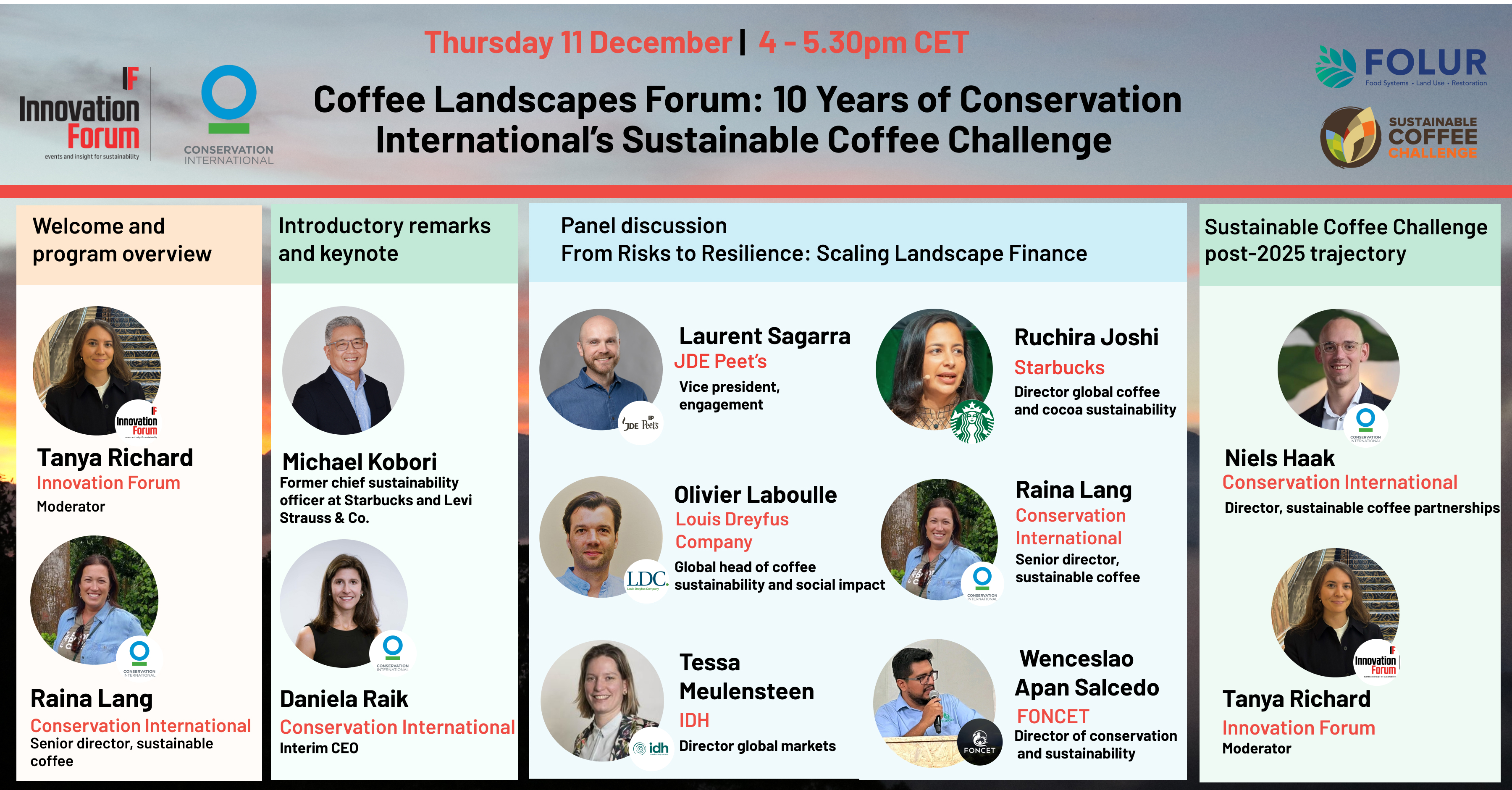
To mark its tenth anniversary, industry leaders, traders, NGOs, field experts, and producers gathered for a milestone virtual event. Hosted by Innovation Forum and Conservation International, the event provided space for reflection, candid discussion, and a shared look forward at what it will take for the coffee industry to thrive in a world increasingly shaped by climate volatility, biodiversity loss, and economic uncertainty.
Across keynote speeches, panel discussions, and the audience Q&A session, one message emerged throughout: the next decade requires investment at scale and bolder collaboration.
The first decade: progress worth celebrating, challenges impossible to ignore
Opening the session, Raina Lang, Senior Director of Sustainable Coffee at Conservation International, reflected on how the Challenge has evolved since its launch.
What began with 18 founding partners has grown into a coalition of more than 120 organisations, spanning roasters, retailers, traders, and other actors across the coffee value chain.
Since its launch, partners have committed a collective $1.4 billion toward sustainability programs through the Challenge, with activities reaching more than 38 coffee-producing countries. Over time, commitments have also become broader and more ambitious, with steadily increasing focus on climate action, nature, and sustainable sourcing.
The Challenge has provided a platform for shared learning, alignment of corporate commitments, partnership building, and progress toward more transparent reporting and more holistic approaches to sustainability. But perhaps the most significant shift over the past decade has been the sector’s growing recognition of climate and nature not as voluntary add-ons, but as core business risks – and the expanding role of traders and other value-chain actors in addressing them.
Climate change: now an immediate, quantifiable business threat
Daniella Raik, interim CEO of Conservation International, stressed this point: “Without thriving nature, the coffee supply chain will continue to face growing threats from climate shocks, land degradation, and biodiversity loss.”
Nature remains undervalued and underfunded, despite underpinning more than half of global GDP. In coffee-growing landscapes, this gap between nature’s value and actual investment is becoming increasingly untenable.
From rising temperatures to erratic rainfall, increasing pest pressures, and more frequent extreme weather events, climate change is already lowering yields, destabilising supply, and threatening the livelihoods of millions of smallholder farmers.
Keynote: why the next decade must look completely different
The keynote address from Michael Kobori, a sustainability expert who has led major global initiatives across apparel, agriculture, and consumer goods sectors including Levi Strauss & Co, set a direct challenge to the audience.
Kobori noted that while sustainability goals historically grew out of corporate values, the conversation today must focus on business imperatives:
Climate change threatens long-term supply
Farmer poverty undermines production stability
Land degradation and biodiversity loss increase risk exposure
As he put it: “We can no longer pursue sustainability solely because of our values. Sustainability must drive value for our businesses.”
Lessons from other industries: progress is possible, but only with structural collaboration
Kobori drew on two major initiatives. The Better Cotton Initiative (BCI) now accounts for approximately 25% of global cotton production and has delivered significant reductions in water use and chemical inputs, underpinned by a robust and inclusive multi-stakeholder governance model. He also highlighted the Zero Discharge of Hazardous Chemicals (ZDHC) initiative, which has driven the rapid elimination of dangerous substances, including PFAS, from global apparel supply chains by bringing together 40 major brands around strict standards, shared accountability, and aligned funding. “Very few initiatives achieve their full goals. But the ones that succeed do so because industry leaders are willing to think and act differently.”
Kobori outlined what coffee will need to reach true scale:
Pooling of individual investments into collective action
Shared and trusted governance
Leadership that prioritises the collective good over individual brand advantage
In his closing, he issued a pointed question: “In these turbulent times, am I doing as much as I can to get the Sustainable Coffee Challenge to that next level of impact?”
From risk to resilience: scaling landscape finance
The panel featured senior leaders from across the supply chain:
Laurent Sagarra, vice president, engagement, JDE Peet’s
Olivier Laboulle, global head of coffee sustainability and social impact, Louis Dreyfus Company
Tessa Meulensteen, director global markets, IDH
Ruchira Joshi, director global coffee and cocoa Sustainability, Starbucks
Raina Lang, senior director, sustainable coffee, Conservation International
Wenceslao Apan Salcedo, director of conservation and sustainability, FONCET
Sustainability is now core business, not CSR
Laurent Sagarra of JDE Peet’s highlighted how deeply climate and nature risks have entered corporate risk management:
98% of JDE Peet’s business is coffee
Coffee sourcing is a top enterprise risk
Farmer livelihoods and nature degradation directly impact business continuity
Despite large-scale investments, major gaps remain. Sagarra pointed out that combined, JDE Peet’s, Starbucks, and Nestlé account for about 25% of the market, meaning many more companies must commit and work together. re consistent regulatory frameworks to create level playing fields.
Landscape investment: essential for resilience
Tessa Meulensteen (IDH) argued that resilience cannot be achieved on farms alone:
Climate shocks operate at landscape scale
Water, biodiversity, and land restoration require joint investment
Short-term budgeting is incompatible with long-term climate risk
IDH is developing stacked risk and benefit models to quantify how landscape investments translate into long-term business value.
The trader perspective: competition and collaboration must coexist
Olivier Laboulle (LDC) stressed that traders cannot simply add sustainability costs unilaterally. “If I add two cents to every pound for sustainability, but buyers won’t pay, we go bankrupt in two years.”
Key points:
Competition drives innovation and efficiency
But many challenges, especially deforestation, MRV, and landscape restoration, require collective, sector-wide action
Public finance is essential to prevent free-riding and align incentives
He credited the Sustainable Coffee Challenge with creating a space – rooted in optimism and positive energy - that offers both technical alignment and a community to sustainability teams across companies.
Field realities: coffee farmers face more than climate risk
Wenceslao Apan Salcedo of Fondo de Conservación El Triunfo A.C. brought attention to the on-the-ground realities in Mexico, from his experiences being involved in the the GEF-financed FOLUR country project in Mexico:
Many farmers are extremely remote and struggle to access international markets
They lack formal credit access
Criminal insecurity and infrastructure collapse hinder transport and sales
He stressed the need for governance strengthening; financial literacy and formalisation, and public investment in restoration, security, and basic infrastructure. These root challenges must be addressed before private investors or global buyers can meaningfully engage.
From the roaster perspective: procurement must evolve
Ruchira Joshi of Starbucks outlined a critical data point emerging from a joint climate risk study with CI: 9 of Starbucks’ top 10 coffee origins are at extreme climate risk. This has triggered a reformulation of procurement strategy:
Development of farm-level intervention action plans across 30,000 farmers
Commitments to purchase at least 50% of production from these supply chains
Regenerative agriculture and carbon reduction integrated into buying decisions
She echoed Kobori’s lessons from cotton: the importance of a shared governance model; the need for sustainable financing mechanisms, and industry collaboration that goes beyond “baking a cake together” and into real delivery. She also highlighted the Hylea Pact in Colombia as an example of companies, government, and communities pooling investments for shared climate and biodiversity outcomes.
Key themes from the Q&A: The hard questions the coffee industry must face
The Q&A surfaced several critical issues. Below are summaries of the panellists’ responses.
How do we ensure farmers thrive, not just comply?
Participants and speakers agreed that farmer livelihoods are the linchpin of the entire system. Key needs discussed:
Technical training
Financial literacy
Access to credit
Compensation during transition periods (e.g., stumping, renovation)
Transparent, fair market incentives
Industry investments remain insufficient relative to the scale of need
What is the role of retailers and regulation?
Sagarra highlighted that retailers and regulators have huge influence. Retailers can require responsible sourcing commitments, demand carbon reduction target and incentivise companies to invest at scale. Regulation can accelerate alignment (e.g., EU Deforestation Regulation), clarify standard and level the playing field. Several speakers acknowledged flaws in the EUDR, even as they credit it with moving the sector forward faster than voluntary action ever has.
What about the risk of free riders?
This remains a barrier to collective investment.
Solutions discussed:
Shared MRV systems
Public–private blended finance
Landscape governance structures
Independent platforms (such as the SCC) to coordinate action
How do we align on MRV (monitoring, reporting, verification)?
Consistency is essential, for companies, donors, and farmers. CI, IDH, and Solidaridad are working on a collective sourcing region MRV model in Colombia, with the potential to scale globally.
The road ahead for the Challenge
Niels Haak (director, sustainable coffee partnerships, Conservation International) closed the event by presenting the next evolution of the Sustainable Coffee Challenge, focused on addressing the dual crises of climate change and nature loss for long-term resilience of coffee’s future.
1. Elevate Ambition and accountability
The Challenge will continue to raise the bar on industry ambition, guiding partners in shaping strong climate and nature strategies – through joint learning and accessible guidance and tools. Increasing focus will be placed on working to align the coffee sector with global frameworks such as the Paris Agreement and the Global Biodiversity Framework. Additionally, central to the effort will be a continued accountability and transparency across the Challenge community, through rigorous stocktake of industry strategies and transition plans on climate and nature
2. Accelerate collective action and innovation
A priority for the coming years is to strengthen the technical foundation needed for coordinated action. This includes building shared datasets, emissions baselines, hotspot analyses, new risk assessment tools, and collaborative MRV systems. The forthcoming Latin America carbon footprint baseline study (covering Brazil, Colombia, Honduras, Mexico, and Peru) illustrates the type of open-source, sector-wide resource the Challenge will continue to deliver.
3. Mobilise aligned finance at landscape scale
To transform coffee-growing regions, the sector must unlock far greater levels of climate and nature finance. The Challenge will offer pathways allowing partners to collectively tap into climate funds, blended finance mechanisms, de-risking tools, and pooled investment models that channel resources into jurisdictional and landscape-scale programs. The forthcoming CI-led AROMA Program, a seven-year, $120 million initiative supported by the Green Climate Fund across four countries, represents a major step in this direction.
A decade of momentum, and a crucial decade to come
The tenth-anniversary event was more than a celebration. It was a frank recognition that:
Climate impacts are accelerating
Farmer livelihoods remain fragile
Corporate sustainability efforts, while impactful, remain fragmented
Regulatory and market pressures are intensifying
Collective action has never been more important, or more possible
Speakers repeatedly returned to the same question: What will it take to transform coffee from a vulnerable global commodity into a resilient, nature-positive one?
If the first decade of the Sustainable Coffee Challenge was about unlocking commitment, aligning on needs, and building momentum, the next must be about:
Systems change, not incremental improvements
Coordinated and pooled investment, not isolated projects
Shared risk, shared investment, and shared benefit
Action that outpaces the accelerating threat of climate change and nature loss
Or, as Michael Kobori framed it: “If you’re willing to collaborate with true collective spirit, you’ll achieve greater impact, attract more funding, and bring more participants to the cause. And together we can realise the dream of making coffee the first truly sustainable commodity.”